Industry research suggests that the majority of job applications are filtered out by automated systems before a human recruiter ever sees them. If you've been applying to dozens of jobs without hearing back, the problem might not be the job market — it might be invisible mistakes you don't even know you're making.
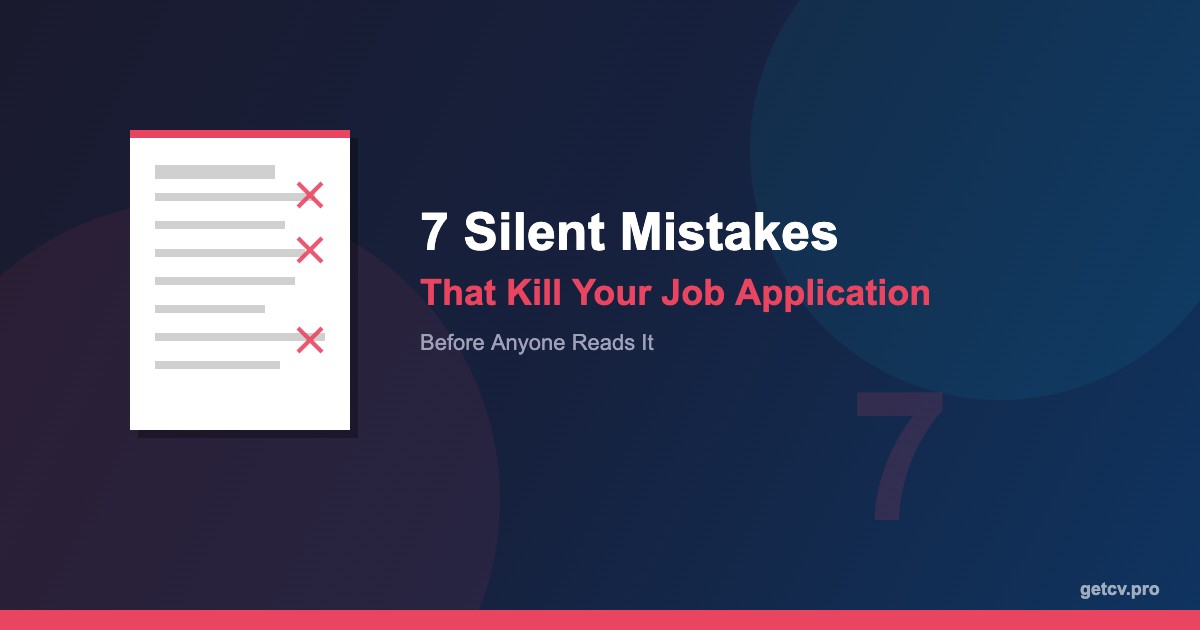
These aren't obvious errors like typos or missing contact information. They're silent killers — habits and oversights that quietly eliminate your application from consideration. The good news? Every single one of them is fixable. Here are seven of the most common, and exactly how to address each one.
1. Submitting the Same Generic CV for Every Job
It's tempting to craft one polished CV and send it everywhere. After all, your experience doesn't change from application to application. But here's the problem: hiring managers can spot a generic application instantly, and so can the software filtering your CV before it reaches them.
A 2023 study published by researchers at Harvard Business School found that candidates who tailored their applications to specific job postings received up to 30% more callbacks than those who submitted generic materials. The reason is straightforward — a tailored CV directly mirrors the language, priorities, and qualifications listed in the job description.
How to fix it: Before submitting any application, compare your CV against the job posting. Identify the top 3-5 requirements and make sure your CV addresses each one explicitly. Adjust your professional summary, reorder your bullet points, and mirror the terminology used in the listing. AI-powered CV tools like GetCV can help you quickly adapt your CV content to match specific job descriptions, saving hours of manual rewriting.
2. Ignoring ATS Keyword Optimization
Most mid-to-large companies use Applicant Tracking Systems (ATS) to manage the flood of applications they receive. According to Jobscan, over 98% of Fortune 500 companies use some form of ATS software. These systems scan your CV for specific keywords related to the job before a recruiter ever sees it.
If your CV doesn't contain the right keywords — even if you're perfectly qualified — the ATS may rank you so low that no human will ever review your application. It's not about gaming the system; it's about speaking the same language as the job posting.
How to fix it: Read the job description carefully and identify recurring terms — specific skills, certifications, tools, and job titles. Incorporate these naturally throughout your CV, particularly in your professional summary, skills section, and work experience bullet points. Don't stuff keywords artificially; instead, describe your real experience using the terminology the employer uses. Tools with ATS scoring features, like GetCV's ATS compatibility checker, can show you exactly how well your CV matches a specific job description and where you're falling short.
3. Using a CV Format That ATS Can't Parse
Ready to build your CV?
Create a professional, ATS-friendly CV in minutes with our AI-powered builder.
Get Started FreeYou spent hours designing a visually stunning CV with creative layouts, infographics, and custom fonts. It looks beautiful on screen — but to an ATS, it's unreadable. Tables, multi-column layouts, headers and footers, text boxes, and embedded images are all common formatting elements that cause ATS parsing failures.
According to a Jobscan analysis of ATS parsing accuracy, resumes with complex formatting can lose up to 25% of their content during parsing. That means a quarter of your experience might simply disappear before anyone reads it.
How to fix it: Use a clean, single-column layout with standard section headings (Work Experience, Education, Skills). Stick to common fonts like Arial, Calibri, or Times New Roman. Avoid tables, text boxes, headers/footers, and graphics. Save your file as a .docx or PDF (check the job posting for format preferences). Professionally designed templates, like those available at GetCV, are built to be both visually appealing and fully ATS-compatible — so you don't have to choose between looking good and getting through the filter.
4. Burying Key Achievements Under Job Duties
There's a critical difference between telling a recruiter what you were responsible for and showing them what you actually accomplished. Too many candidates write bullet points like "Managed a team of developers" or "Responsible for customer service operations." These describe duties, not achievements.
A LinkedIn survey of over 1,200 hiring managers found that 63% said they were more likely to interview candidates who quantified their accomplishments. Numbers, percentages, and measurable outcomes immediately signal competence and impact.
How to fix it: Rewrite your bullet points using the formula: Accomplished [X] by doing [Y], which resulted in [Z]. For example, instead of "Managed social media accounts," write "Grew social media engagement by 45% over six months by implementing a data-driven content strategy, resulting in a 20% increase in qualified leads." If you don't have exact numbers, use reasonable estimates and ranges. Even approximate metrics are more compelling than no metrics at all.
5. Skipping Company Research Before Tailoring the Application
The spray-and-pray approach — submitting applications to every open position as quickly as possible — feels productive. But hiring managers report that they can immediately identify candidates who haven't taken the time to understand the company or the role.
According to a Glassdoor survey, 88% of hiring managers said that an informed candidate is a quality candidate. When your application shows zero awareness of the company's mission, recent projects, or industry challenges, it signals that you'd accept any job — which, paradoxically, makes you less attractive for this specific one.
How to fix it: Before applying, spend 15-20 minutes researching the company. Check their website, recent news coverage, LinkedIn page, and Glassdoor reviews. Identify 2-3 things that genuinely interest you about the organization. Then reflect this knowledge in your professional summary or cover letter. Something as simple as "Drawn to [Company]'s commitment to [specific initiative]" demonstrates effort and genuine interest — and sets you apart from the hundreds of applicants who didn't bother.
6. Having No Online Professional Presence
Your CV isn't the only thing recruiters evaluate. A CareerBuilder survey found that 70% of employers use social media to screen candidates during the hiring process, and 57% have decided not to hire a candidate based on what they found online. Conversely, 47% said they were less likely to interview someone they couldn't find online at all.
Having no LinkedIn profile — or a bare, outdated one — is a missed opportunity at best and a red flag at worst. In today's hiring landscape, your online presence is an extension of your CV.
How to fix it: Build a complete LinkedIn profile that mirrors and expands on your CV. Add a professional photo, write a compelling headline (not just your job title), and craft a summary that tells your professional story. Request recommendations from former colleagues. Engage with industry content by sharing articles and commenting thoughtfully. Finally, Google yourself — if the first page of results doesn't reflect the professional image you want to project, take steps to address that.
7. Never Following Up After Applying
You submitted your application and now you're waiting. Days pass. Then weeks. You assume silence means rejection. But in many cases, your application is sitting in a queue with hundreds of others, and a brief, professional follow-up can be the difference between getting noticed and getting lost.
A Robert Half survey found that 81% of hiring managers said that receiving a follow-up from a candidate positively influenced their perception of that applicant. Despite this, the majority of candidates never follow up at all — which means doing so immediately puts you ahead of most of the competition.
How to fix it: Wait 7-14 days after submitting your application, then send a brief, professional follow-up email. Keep it to 3-4 sentences: restate your interest in the role, mention one specific qualification that makes you a strong fit, and express enthusiasm for the opportunity to discuss further. If you can identify the hiring manager on LinkedIn, a polite connection request with a short personalized note can also be effective. Don't follow up more than twice — persistence is a virtue, but overreach is a disqualifier.
The Bottom Line
These seven mistakes share something in common: they're all invisible to the candidate who's making them. You won't get a rejection email that says "Your CV was eliminated by our ATS because you used a two-column layout." You'll simply never hear back — and you'll blame the job market instead of the fixable errors in your process.
Here's a quick checklist to review before your next application:
- Tailor your CV to each specific job description
- Optimize for ATS keywords drawn directly from the job posting
- Use a clean, parseable format — no tables, graphics, or fancy layouts
- Lead with achievements, not job duties — use numbers whenever possible
- Research the company before applying and reflect that knowledge in your materials
- Build your online presence — especially LinkedIn
- Follow up professionally within two weeks of applying
Every one of these fixes is within your control, and implementing even a few of them can dramatically improve your callback rate. If you want to get started right away, GetCV's AI-powered CV builder can help you create a professionally formatted, ATS-optimized CV tailored to your target roles — so you can focus on what matters most: preparing for the interview.